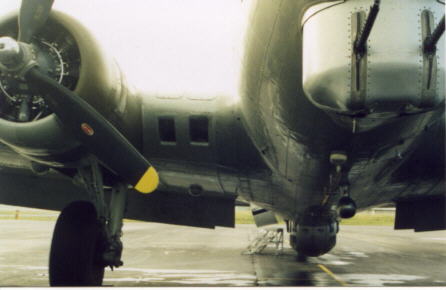
Starboard wing root.
A few months later I learned that the EAA took the Aluminum Overcast around the US giving tours. The chance to fulfill my dream was at hand, but the cost was a bit steep. When I told my wife of this opportunity she insisted I go, and offered to pay the bill. I protested, but she convinced me we could do this, and insisted I go fly. I made my arrangements and on May 23, 1999 I arrived for my first B17 ride.
I arrived two hours early. This gave me time to check in, get a short briefing, and then check out the plane. Few people were there and that enabled me to get up to the plane without being in anyone's way, or anyone in mine. I walked around the aircraft studying all the details. I stood in the wheel well, ran my hand along the wing and stared up into the nose cone. It was beautiful, but not as big as I envisioned.
I analyzed the wings: The Clark wing has a large surface area which provides a lot of lift and has a relatively low stall speed compared to the B24. However, the long cord does increase drag, reducing the aircraft's cruise speed. Moving along the waist I noticed how it narrowed. This may prove a problem moving through the aircraft. I stand 6' 2" and suspected the ceiling height was slightly less.
The horizontal stabilizer was huge. Its span was larger than the wingspan of many fighter's. The stabilizer was about chest high and I examined the controlling surfaces. During WWII the control surfaces were made of a resin impregnated fabric which reduced the weight of the aircraft. This material had a more modern origin and felt more like a drum head, and had a similar sound when I thumped it. The rudder and ailerons used the same material.
Copyright © 1998-2026, 486th Bomb Group Association.

The B17's split flap.
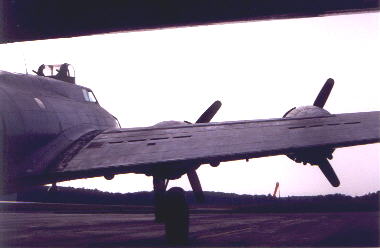
The Clark wing.